ఏనుగు పర్యాయపదాలు A Complete Guide to Synonyms for Elephant
In Indian history, mythology, and Telugu culture, the Elephant (ఏనుగు - Enugu) is a symbol of royalty, wisdom, and majestic strength. From temple processions (Gaja Vahanam) to ancient battlefield cavalries, the elephant is deeply respected.
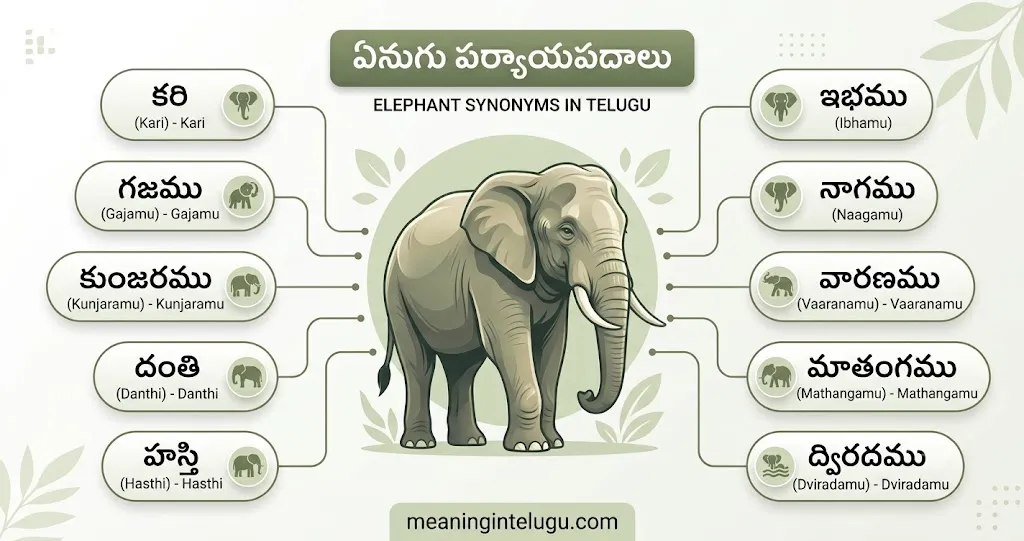
Because of its unique physical features like its long trunk, large tusks, and massive size ancient Sanskrit and Telugu scholars coined highly descriptive and logical names for it. If you are a student preparing for board exams, an aspirant for APPSC/TSPSC competitive exams, or reading classical texts like Gajendra Moksham, mastering Enugu Paryaya Padalu (ఏనుగు పర్యాయపదాలు) is essential.
In this comprehensive guide, we have compiled the ultimate list of synonyms for Elephant in Telugu. We have categorized them by their literal meanings, complete with English pronunciations, so you can memorize them logically rather than blindly!
Want the meaning of another Telugu word?
Search our complete English-Telugu dictionary below!
1. Basic & Common Synonyms (సాధారణ పర్యాయపదాలు)
These are the most common synonyms you will encounter in everyday language, news articles, and standard Telugu grammar textbooks. They are heavily based on the elephant's physical appearance.
| Telugu Synonym | Pronunciation | Literal Meaning / Description |
|---|---|---|
| Telugu Synonymగజం | PronunciationGajam | MeaningElephant (The most standard formal word, often used in names like Gajanana or Gajendra) |
| Telugu Synonymకరి | PronunciationKari | MeaningThe one with a trunk ("Karam" means hand/trunk in Sanskrit) |
| Telugu Synonymదంతి | PronunciationDanthi | MeaningThe one with tusks ("Dantham" means tooth or tusk) |
2. Advanced & Poetic Synonyms (సాహిత్య మరియు పౌరాణిక పర్యాయపదాలు)
These synonyms are frequently asked in competitive exams (TET, DSC, Group 1 & 2) and are widely used in classical Telugu poetry (Kavyalu). They describe the elephant's behavior, habitat, and majestic nature.
| Telugu Synonym | Pronunciation | Literal Meaning / Description |
|---|---|---|
| Telugu Synonymకుంజరం | PronunciationKunjaram | MeaningThe one that roams in dense forests or bushes (Kunja = bush/forest) |
| Telugu Synonymవారణం | PronunciationVaaranam | MeaningThe one that wards off or destroys enemies (Used historically for war elephants) |
| Telugu Synonymమాతంగం | PronunciationMaathangam | MeaningA majestic, powerful elephant |
| Telugu Synonymద్విపం | PronunciationDwipam | MeaningThe one that drinks twice ("Dwi" = two, "Pa" = to drink. It first takes water in its trunk, then pours it into its mouth!) |
| Telugu Synonymసింధురం | PronunciationSindhuram | MeaningAn elephant (often referring to a royal or musth elephant) |
| Telugu Synonymనాగము | PronunciationNaagamu | MeaningElephant (Note: In Telugu and Sanskrit, Naagamu can mean either a Snake or an Elephant depending on the poetry's context) |
3. Practical Usage (వాక్య ప్రయోగం)
To score full marks in your Telugu exams, you must know how to frame these words into proper sentences (Vakya Prayogam). Here is how you can use these synonyms correctly in everyday contexts and literature:
1. Enugu (ఏనుగు)
Telugu: అడవిలో ఏనుగుల గుంపు నీరు తాగుతోంది.
English: A herd of elephants is drinking water in the forest.
2. Gajam (గజం)
Telugu: పూర్వకాలంలో రాజుల సైన్యంలో గజదళం అత్యంత కీలకమైనది.
English: In ancient times, the elephant cavalry (Gajadalam) was highly crucial in kings' armies.
3. Danthi (దంతి)
Telugu: దంతి దంతాలు చాలా విలువైనవి మరియు అందమైనవి.
English: The tusks of the elephant (Danthi) are very valuable and beautiful.
4. Kari (కరి)
Telugu: మకరి (మొసలి) పట్టుకున్నప్పుడు, కరి (ఏనుగు) దేవుడిని ప్రార్థించింది.
English: When caught by the crocodile (Makari), the elephant (Kari) prayed to God. (A famous reference from the Gajendra Moksham story).
5. Kunjaram (కుంజరం)
Telugu: అడవిలో ఒక పెద్ద కుంజరం చెట్ల కొమ్మలను విరుస్తోంది.
English: A large elephant (Kunjaram) is breaking tree branches in the forest.
4. Frequently Asked Questions (FAQs)
What are the most common synonyms (paryaya padalu) for Enugu?
The most commonly used synonyms for an Elephant in Telugu are Gajam (గజం), Kari (కరి), Danthi (దంతి), and Kunjaram (కుంజరం).
Why is an elephant called 'Dwipam' (ద్విపం)?
This is a highly popular question in Telugu grammar! The word Dwipam is made of two parts: "Dwi" (twice) and "Pa" (to drink). Because an elephant cannot drink directly with its mouth, it first sucks water into its trunk (step 1), and then squirts it into its mouth (step 2). Hence, it is literally called "the one who drinks twice."
Why is it called 'Kari' (కరి) and 'Danthi' (దంతి)?
In Sanskrit and Telugu, words are often formed based on physical traits. "Karam" means a hand or a trunk, so the animal with a prominent trunk is called Kari. Similarly, "Dantham" means tooth/tusk, so the animal known for its massive tusks is called Danthi.